
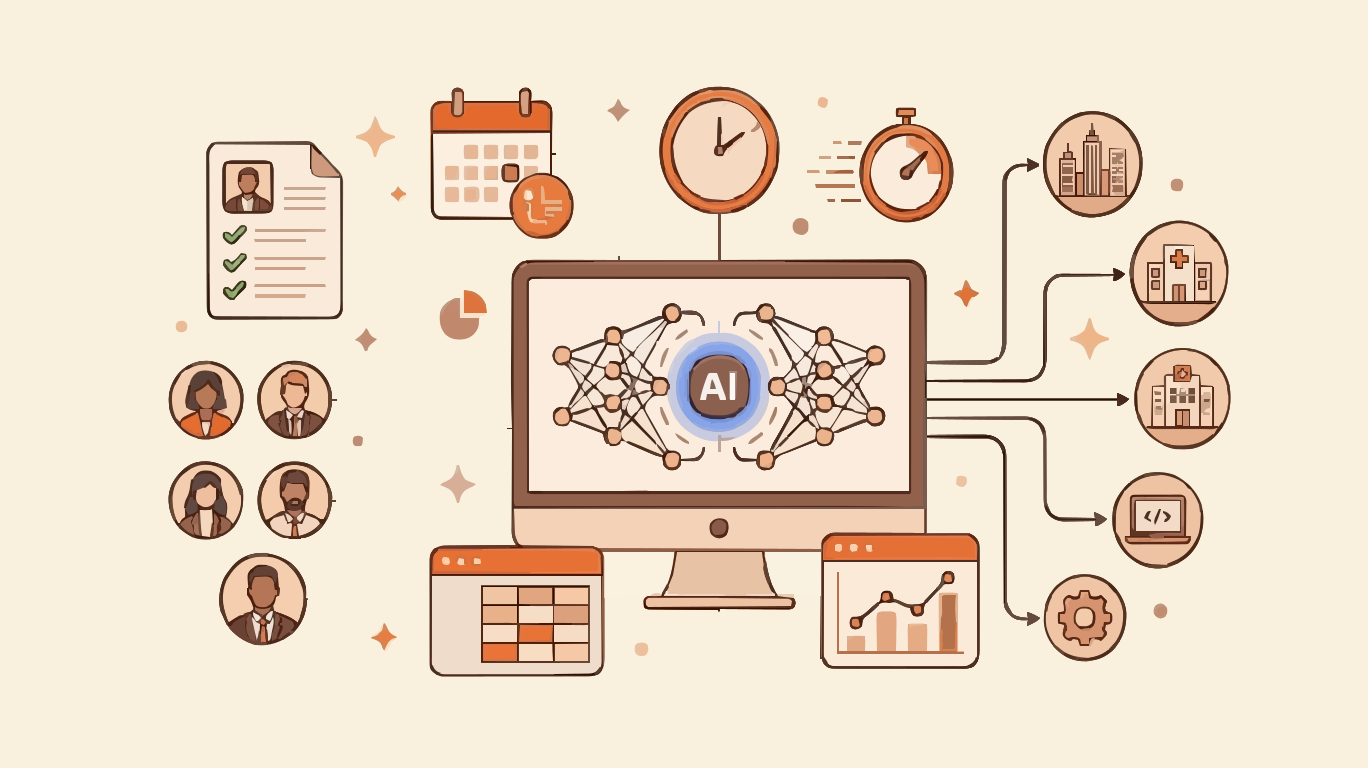
You applied for a job, uploaded your resume, and waited. Then came a rejection or silence. Sounds familiar? We all have gone through this phase of our careers. A few years back, we knew that only humans screened our resumes. But over the past couple of years, the trend in hiring has changed. Because hiring companies don't depend only on humans anymore, they use AI for recruitment. Fast and impactful process to get through hundreds of resumes in one go.
AI recruitment is the use of artificial intelligence to make parts of the hiring process a little easier. This can mean that AI is evaluating or organising your application before a recruiter reviews it.
And it's already happening at scale. In 2026, Deloitte India conducted a campus talent research study. That research shows that 86% of surveyed organisations know that AI or agentic AI is transforming recruitment, while 72% agree they use AI for resume screening. 48% of organisations report AI-based assessments.
But what does that actually mean when you're the person applying for the job?
Does AI read your resume? Can it reject you? What happens during an AI interview? Is AI recruitment fair? And, perhaps most importantly, how can you prepare without trying to “game” the system?
What Is AI Recruitment?
AI recruitment is the use of artificial intelligence to help employers make the repetitive and manual process of hiring easier. From a job seeker's perspective, AI is often used as an early-stage filter or as a tool that supports your decision. Not the person making the final hiring decision.
In simple terms, imagine a company receives thousands of applications for one position. Instead of manually examining every application from the beginning, AI-powered software can help organise those hundreds of applications in a structured way.
AI can quickly and efficiently process your relevant skills, experience, qualifications, or other information related to the job description. A recruiter can then use that information to decide which candidates are ideal for that job role.
AI can appear at several points in recruitment:
- Resume screening:to identify relevant skills and experience
- Candidate matching:to compare your profile with available roles
- Online assessments:to help evaluate specific skills
- AI interviews:to ask questions or process interview responses
- Candidate communication:to answer questions or handle routine updates
But “AI recruitment” does not necessarily mean a computer makes the entire hiring decision. AI is used only to speed up the hiring process and support the workflow. Recruiters or hiring managers make the final decision.
What Happens When AI Screens Your Resume?
AI resume screening is basically software that reads through your application and checks whether it matches the job description. The job of an AI depends on which system a company uses. Based on that, it might sort, rank, or flag candidates for a recruiter to look at more closely.
Let's say a company is hiring a digital marketing specialist and gets hundreds of applications. An AI system might look at things like:
- Relevant job experience
- Technical and professional skills
- Education
- Certifications
- Previous roles
- Industry experience
- Achievements
- Any other qualifications relevant to the job
From there, it can help highlight the candidates whose backgrounds fit the role.
That's quite different from the common assumption that AI just looks for exact keywords and automatically rejects anyone who doesn't use the “right” keyword.
Do keywords matter?
The right terminology can definitely make your experience clear, but keyword stuffing is not always a good strategy.
If a job requires SEO experience, for example, and you genuinely have SEO experience, describing that experience clearly is useful.
Instead of writing:
“Worked in digital marketing.”
you could write:
“Managed SEO campaigns that increased organic search traffic by 35%.”
The second version actually shows what you did and what the outcome was.
You should not manipulate an automated system by using “SEO” dozens of times in white text in your resume.
That kind of tactic is very risky. There's been reporting of candidates hiding instructions in white text inside their resumes to influence the AI screening process. To prevent that fraudulent behaviour, employers are coming up with new ways to detect it.
Your safest approach is much simpler:
Make your real qualifications specific, relevant, and easy to understand.
AI screening systems vary. No two companies use AI for the same purpose, and the exact technology and level of automation depend on the employer.
What Happens in an AI Video Interview?
It is an interview process where artificial intelligence is used to ask questions, process your responses, or help evaluate what you have said in the interview.
The format of the interview is not the same everywhere. It depends on the employer.
In most cases, you will get a link, a question will appear on your screen, you will get some time to prepare, and then you have to record your answer. Some companies keep the questions the same so that candidates are asked the same things. This makes the evaluation genuine.
In other cases, AI is used to transcribe or summarise an interview while the final decision is still made by a human recruiter.
What is actually being assessed in an AI Video Interview?
This is exactly where a lot of candidates get unnecessarily anxious.
There's a common notion that AI interviews judge everything from your facial expressions to how confident you look on camera.
But honestly, that is not something that you should assume.
A well-designed interview system can focus on your actual answer and whether it shows the skills or competencies that the job requires. The system may process your spoken response, transcript, structured answers, or other job-relevant information. That entirely depends on the system that the company uses.
A typical AI interview might assess areas such as:
- Communication
- Problem-solving
- Role-specific knowledge
- Situational judgment
- Teamwork
- Leadership
- Your ability to explain previous experience
The advantage of a structured interview is its consistency. You get comparable questions and evaluation criteria rather than depending entirely on whether the interviewer is in a good mood that day or has some personal preferences.
But consistency alone doesn't make something fair. The system still needs appropriate design, testing, transparency, and human oversight.
If the thought of an AI interview is making you nervous, don't waste your time guessing what facial expression the camera is looking for.
Instead, put your energy into preparing clear, honest, structured answers about your actual experience.
Is AI Recruitment Fair?
AI recruitment can be useful, but it doesn't make the process automatically fair simply because a computer is making or supporting the assessment.
AI systems too can be biased for several reasons. Sometimes it's because they are trained on biased data; sometimes they are designed around inappropriate criteria that are not right for the job; or they are used without sufficient testing and oversight.
Independent research has found evidence that this concern is real.
A 2026 Stanford-reported study analysed 4 million applications processed by an AI-based screening tool, and it found racial differences in recommendations for some jobs. White candidates were recommended more often than Black and Asian candidates, in most cases. The researchers said that AI hiring systems need to be far more transparent and undergo proper testing.
However, that doesn't mean AI is biased, nor does every AI interview.
It means employers need to make sure the systems they use are properly designed and tested.
What makes an AI hiring system more trustworthy?
There are three things that you should look for:
- 1Transparency:You should have a clear idea of what is the role of AI in the process.
- 2Human oversight:AI output is not the final verdict for the hiring.
- 3Bias testing:Employers and technology providers should test their systems for potentially discriminatory outcomes and fix the problems once identified.
For candidates, transparency really matters because at the end of the day they have the right to know what they're being evaluated on.
If you're unsure, it's fair to ask:
“Is AI being used to evaluate my interview, and will a recruiter review the results?”
Because AI should make recruitment more structured—not turn the process into something that candidates can't understand.
What This Looks Like for Job Seekers in India
AI recruitment is no longer just something candidates need to think about when applying to large technology companies overseas.
It is becoming part of India's hiring landscape too.
A recent study published in SN Business & Economics shows how Indian employers are relying on AI these days. Researchers interviewed 14 HR and IT professionals from four Indian IT companies. They found that these companies were using digital and AI-enabled tools at several stages of the hiring process. From finding candidates, screening resumes, scheduling interviews and communicating with applicants. But at the same time, recruiters still play an important role when it comes to making final selection decisions.
The use of AI has increased a lot. Recruiters manage the hiring process with the help of AI, but that does not mean a machine is making the final decision about whether you get the job.
A hiring journey might look something like:
But this is not mandatory for all Indian companies to follow this process. Different companies practice different recruitment processes, and those depend on the industry, role, and hiring volume.
So, instead of learning tricks to manipulate AI systems, it's better to be comfortable with digital applications, structured assessments, and AI-assisted interviews.
Just make sure your actual skills and experience are easy to identify, and they easily demonstrate your ability.
How to Prepare for an AI-Screened Job Application
You don't need to trick AI recruitment software.
In fact, trying to do so can make your application less credible.
Instead, focus on showing what you are capable of.
- Match your resume to the role
First things first, you have to read the job description carefully and identify the skills and experience the job actually requires.
If you genuinely have those skills, describe them clearly in your resume.
- Use specific language
Don't use any vague statements such as:
“Responsible for various marketing activities.”
Be more specific about your work and the specific output data:
“Created SEO content strategies and increased organic traffic by 30%.”
You can make an AI recruitment software understand your experience by explaining your work experience in clear language.
- Don't hide keywords
Don't try to manipulate automated screening by using white text, invisible keywords, or excessive repetition of keywords.
You don't need to make your resume look like a list of search terms.
- Prepare structured interview answers
For behavioural questions, you can follow the Situation–Action–Result structure.
Try to explain:
- What was happening?
- What did you personally do?
- What happened as a result?
This is much stronger than giving a vague answer about what your “team” accomplished.
- Practice speaking naturally
AI interviews can feel unusual because you may be talking to a screen instead of a person.
Practice answering questions aloud, so you're comfortable explaining your experience without reading from a script.
- Prepare for role-specific questions
Don't only practice:
“Tell me about yourself.”
Prepare for questions that test the actual skills required for your target role.
- Understand the process
If an employer tells you an interview is AI-assisted, check what the platform actually does.
If the information isn't clear, it is good to ask.
Your goal isn't to perform for an algorithm. It's to communicate your ability to do the job clearly and honestly.
Frequently Asked Questions
Try It Yourself
Experience Zepcruit's AI mock interview before real one.
No demo call. No recruiter pitch. Just practice.